GHK-Cu has one of the longer research histories of any peptide sold today — over five decades since its discovery — and a correspondingly large body of published literature. That also means it's easy to find confident claims about it that outrun what the studies actually measured. This is a walkthrough of what's genuinely well-documented, what's promising but preliminary, and what still isn't settled.
Everything below describes laboratory and preclinical research. GHK-Cu sold by peptide suppliers is intended strictly for research use only, not for human or animal consumption.
What GHK-Cu Is and How It Was Discovered
GHK-Cu (glycyl-L-histidyl-L-lysine-copper(II), or "copper peptide") is a naturally occurring tripeptide-copper complex first isolated from human plasma in 1973 by biochemist Loren Pickart. Pickart's early research found that plasma from younger donors helped aged liver tissue behave more like young tissue in culture, and traced that regenerative signal to this small copper-binding peptide. GHK-Cu levels in human plasma are known to decline with age — roughly 200 ng/mL around age 20 versus roughly 80 ng/mL by age 60 in the studies that have measured this — which is part of why it's studied as a marker and potential lever in aging and tissue-repair research.
The Well-Established Mechanism: Tissue Remodeling
GHK-Cu's best-documented biological role is as a signal molecule in tissue remodeling, the phase that follows the initial inflammatory response to injury. Across decades of published research, GHK-Cu has been shown to:
- Stimulate collagen, elastin, and proteoglycan synthesis — at very low, nanomolar concentrations, according to research from Maquart and colleagues going back to the 1990s.
- Modulate matrix metalloproteinases (MMPs) and their inhibitors (TIMP-1, TIMP-2) — the enzyme system that balances tissue breakdown and rebuilding during healing.
- Promote angiogenesis — new blood vessel formation, via increased expression of VEGF and basic fibroblast growth factor, which helps restore blood flow to damaged tissue.
- Act as an antioxidant and anti-inflammatory signal — suppressing free radical activity and pro-inflammatory cytokines including TNF-alpha in various models.
- Accelerate wound healing across species — documented in rabbits, rats, mice, pigs, and dogs, including diabetic and ischemic wound models where it reduced inflammatory markers and increased collagen deposition.
A 2001 study by McCormack and colleagues found GHK-Cu restored replicative capacity to fibroblasts damaged by radiation therapy, and human skin biopsy studies (applying topical GHK-Cu creams for one month) found significant increases in collagen production — outperforming both vitamin C and retinoic acid comparator creams in that particular study.
Skin Research: Where the Evidence Is Strongest
Controlled studies on aged skin are where GHK-Cu's research base is most mature. Published findings include improvements in skin elasticity, firmness, and density, along with reductions in fine lines, wrinkles, photodamage, and hyperpigmentation. This is the application with the deepest and most consistent evidence trail, spanning both cell-culture mechanism work and applied human studies.
Hair Research: Promising Preclinical Signal, Limited Human Data
The hair-growth research on GHK-Cu is scientifically interesting but earlier-stage than the skin data. Pickart's own 1993 mouse study found topical copper peptide application increased hair follicle size by roughly 50% and shifted follicles from the resting (telogen) phase back into active growth (anagen). A separate small double-blind human trial from the same era found a topical GHK-Cu solution produced hair density improvements comparable to 5% minoxidil over six months — but the sample size was small and the study has not been replicated at scale.
Later human studies used combination formulations (branded as Tricomin, containing copper peptides alongside other ingredients) rather than GHK-Cu in isolation, which makes it harder to attribute results to GHK-Cu specifically. A separate mechanism study identified Wnt/beta-catenin pathway activation as one route by which copper peptides may influence follicle biology, but this is mechanistic cell-based evidence, not a clinical outcome measure.
The honest summary: GHK-Cu has a genuine, mechanistically plausible signal for hair follicle activity, best-supported in animal models and small early human trials, with the strongest human data coming from combination formulations rather than GHK-Cu alone.
How GHK-Cu Compares to Minoxidil
| GHK-Cu (topical) | Minoxidil | |
|---|---|---|
| Mechanism | Matrikine signaling, follicle remodeling, Wnt pathway | Vasodilation, potassium channel opening |
| Regulatory status | Not FDA-approved for hair loss | FDA-approved (2% and 5% topical) |
| Human trial base | Small, early-era studies; limited replication | Large, multi-decade clinical trial base |
| Direct head-to-head data | One small comparable-outcomes study (1990s) | Same study, as comparator |
Minoxidil has a substantially larger and more rigorous human evidence base. GHK-Cu's comparable results in the one available head-to-head study are notable but come from a study too small to be considered definitive.
Handling and Documentation for Research Use
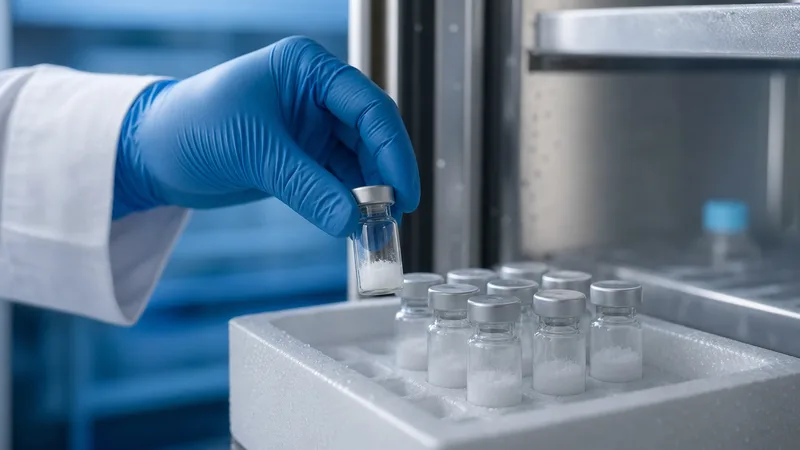
Reconstitution and storage practices for GHK-Cu follow the same general principles as other lyophilized research peptides — refrigeration after reconstitution, protection from light, and avoiding repeated freeze-thaw cycles. Our full walkthrough is in the peptide storage and reconstitution guide, with vial-specific protocols for 50mg and 100mg vials, and the Tri-Heal blend protocol for labs studying combination approaches. The research volume helper covers concentration math for any vial size.
Third-party HPLC documentation confirms batch identity and purity independent of storage practice; see our guide on how to read a peptide COA, check available batch documentation with the COA lookup tool, and review our research compliance page. Current GHK-Cu vial sizes are listed on the GHK-Cu product page.
What the Data Doesn't Yet Tell Us
Most of GHK-Cu's strongest evidence comes from animal wound-healing models and small, decades-old human studies rather than large modern randomized controlled trials. The hair-growth literature in particular would benefit from a properly powered, GHK-Cu-only (not combination-formula) human trial using current trichoscopy and hair-count methodology. The systemic (injectable, versus topical) research base is also considerably thinner than the topical/dermatological literature, which matters for interpreting any claims outside topical skin and scalp applications.
Common Questions
Is GHK-Cu proven to regrow hair? No single study proves this conclusively. The preclinical and small early human data are promising and mechanistically plausible, but the evidence base is smaller and older than what's available for FDA-approved options like minoxidil.
What's the difference between GHK-Cu and AHK-Cu? AHK-Cu is a synthetic analog developed for enhanced stability; it has shown comparable effects in some hair-follicle research but is a distinct compound with its own separate research base.
Is GHK-Cu naturally occurring or synthetic? Both. GHK-Cu occurs naturally in human plasma, saliva, and urine, and is also manufactured synthetically for research use. The forms are chemically identical.
Is GHK-Cu FDA-approved? No. It is not approved as a drug for any indication in the United States. Research-grade GHK-Cu sold through peptide suppliers is intended for laboratory research only.
Glossary
Matrikine: A signaling peptide released during extracellular matrix breakdown that triggers tissue repair processes — the functional category GHK-Cu belongs to.
Angiogenesis: The formation of new blood vessels, important for restoring blood flow to healing tissue.
Matrix metalloproteinase (MMP): An enzyme family that breaks down extracellular matrix proteins during tissue remodeling; GHK-Cu modulates both MMPs and their natural inhibitors.
Anagen / telogen: The active growth phase and resting phase of the hair follicle cycle, respectively.
References
- GHK Peptide as a Natural Modulator of Multiple Cellular Pathways in Skin Regeneration. BioMed Research International, 2015. Read the study
- Pickart, L., Margolina, A. The Human Tripeptide GHK-Cu in Prevention of Oxidative Stress and Degenerative Conditions of Aging. International Journal of Molecular Sciences / PMC. Read the study
- The human tri-peptide GHK and tissue remodeling. Journal of Biomaterials Science, Polymer Edition. View abstract
Research Use Only. Not for human or animal consumption.