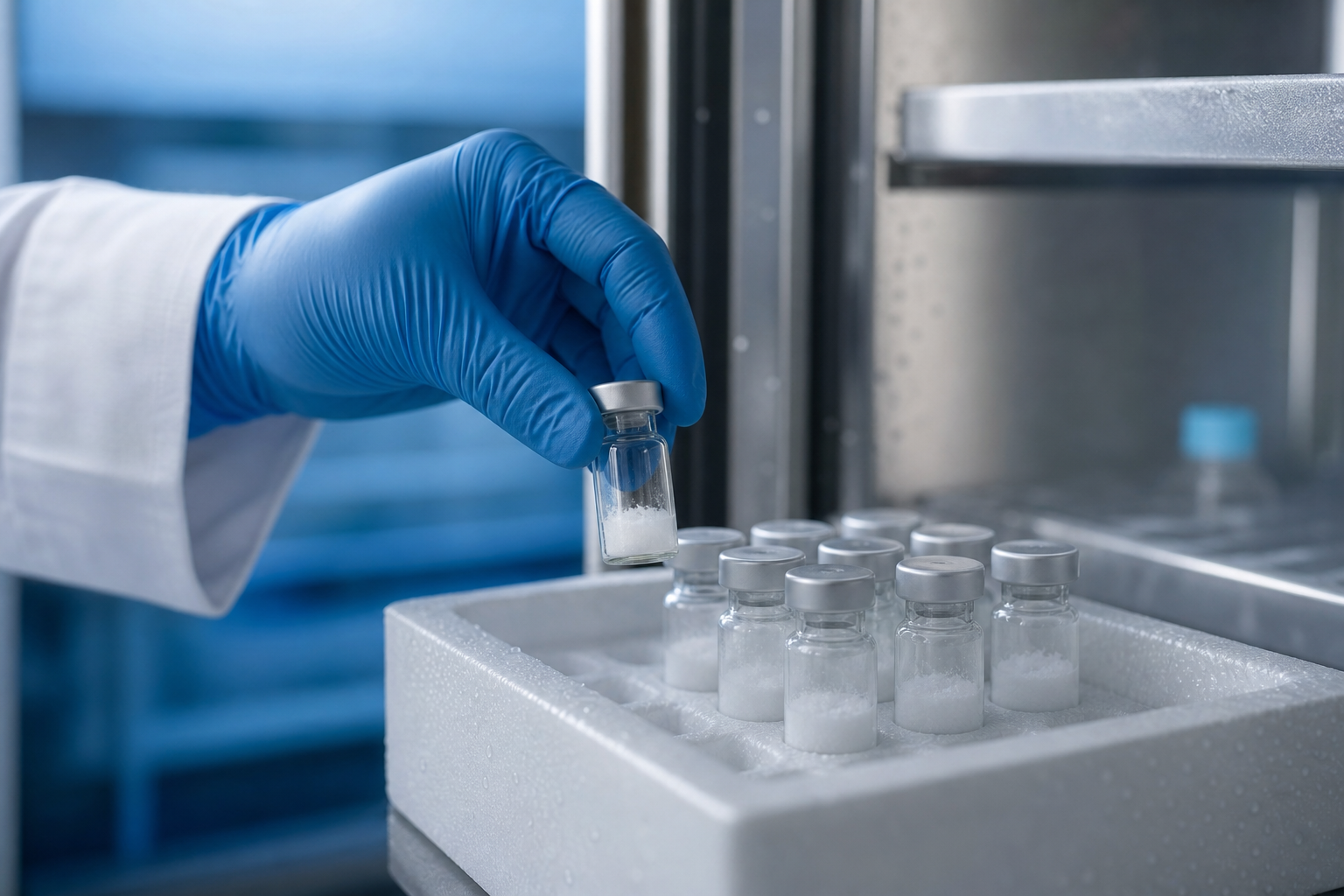
Most guidance on peptide storage boils down to "keep it cold and use it fast," which is true but incomplete. A 2026 pharmaceutical review of BPC-157 in Pharmaceutics laid out the compound's stability chemistry in unusual detail, and it turns out BPC-157's specific amino acid sequence gives it a genuinely different risk profile than most research peptides — better in some ways, and worse in one specific spot.
Everything below is intended for laboratory research use only. BPC-157 is not FDA-approved for human or animal use, and none of the handling information here is medical guidance.
Why Reconstitution Is the Real Stability Event
Lyophilized (freeze-dried) peptide is chemically dormant. Removing water removes both the reactant for hydrolysis and the molecular mobility peptides need to unfold and degrade. Reconstitution reverses both of those protections at once — which is why a peptide that's stable for months as a dry powder can start degrading within days once it's dissolved.
Five distinct chemical and physical pathways drive that degradation, and each responds to a different environmental variable:
| Degradation pathway | What it does | Primary driver |
|---|---|---|
| Hydrolysis | Water breaks peptide bonds at vulnerable junctions | Temperature, pH |
| Oxidation | Reactive oxygen damages susceptible residues (Met, Trp, Cys) | Light, oxygen exposure |
| Deamidation | Asparagine/glutamine residues convert to aspartate/glutamate | Temperature, pH |
| Aggregation | Peptide molecules clump into inactive or immunogenic particles | Concentration, agitation, freeze-thaw |
| Adsorption | Peptide sticks to glass or plastic container walls, reducing effective dose | Container material, concentration |
What Makes BPC-157's Sequence Different
BPC-157 is a 15-amino-acid sequence (GEPPPGKPADDAGLV, ~1419 Da) originally identified in human gastric juice research by Sikiric and colleagues at the University of Zagreb. The 2026 Pharmaceutics review breaks down exactly why its chemistry behaves differently from a typical research peptide:
- No methionine, tryptophan, or cysteine — this eliminates the primary oxidative degradation pathways that affect most peptides. BPC-157's oxidation risk is unusually low by sequence composition alone.
- No asparagine or glutamine — this removes deamidation as a concern entirely, another pathway that commonly limits peptide shelf life.
- Three consecutive proline residues (positions 3–5) — proline's rigid ring structure restricts the backbone flexibility that drives both enzymatic cleavage and the beta-sheet formation behind aggregation. This is also the structural basis for BPC-157's well-documented resistance to gastric acid and pepsin.
- An Asp10–Asp11 junction — this is the one clear liability in the sequence. Aspartate-adjacent junctions are a recognized hotspot for hydrolysis and succinimide formation under mildly acidic to neutral conditions, and the review identifies it as the primary chemical degradation risk specific to this peptide.
The net result: BPC-157 has an unusually favorable oxidative and deamidation profile compared to most linear peptides, one identifiable hydrolysis hotspot to be mindful of, and — at the microgram research doses typically used — a real (if rarely discussed) risk of measurable losses to adsorption on glass or plastic container surfaces.
Practical Storage Windows
None of the sequence-specific chemistry above changes the basic handling rules that apply to reconstituted peptides generally:
- Lyophilized (unreconstituted) vials: Refrigerate at 2–8°C. For storage beyond a few months, freezing at −20°C is standard practice for unreconstituted powder.
- Reconstituted with bacteriostatic water: Refrigerate at 2–8°C immediately after preparation. Most reconstituted peptides remain within an acceptable stability window for roughly 2–4 weeks under refrigeration; the 0.9% benzyl alcohol in bacteriostatic water controls microbial growth but does not stop chemical degradation.
- Avoid repeated freeze-thaw cycles. Each cycle introduces ice-crystal formation and localized freeze-concentration effects that stress the peptide structure. If long-term frozen storage of reconstituted material is unavoidable, aliquot into single-use volumes first.
- Protect from light. Even with BPC-157's low oxidation risk from its sequence, UV and visible light exposure is a good habit to avoid across all peptide handling. Amber vials or a dark refrigerator drawer are sufficient.
- Watch for adsorption at low concentrations. At the microgram-range concentrations common in research protocols, a meaningful fraction of peptide can adsorb to glass or plastic surfaces. Consistent container material and gentle (not vigorous) mixing help minimize this.
For full technique, see the peptide storage and reconstitution guide. For vial-specific reconstitution math, the research reference protocols cover both BPC-157 sizes: 5mg and 10mg, as well as common blends like the BPC-157/TB-500 10mg blend. The research volume helper works through concentration math for any vial size, and bacteriostatic water is available separately if needed.
Consistent cold storage matters enough that dedicated hardware is worth considering for any lab handling multiple vials — a CoreVault storage case or vial protector pods reduces accidental temperature excursions and physical damage between refrigerator and bench.
Signs a Vial Has Degraded
Visual inspection won't catch every degradation pathway, but it catches the obvious ones. Before use, check for:
- Cloudiness or haze — a sign of aggregation or precipitation.
- Visible particles or flocculent material — do not use; this indicates significant physical degradation.
- Color change — properly stored BPC-157 solution should remain clear and colorless.
None of these checks can detect chemical degradation (like hydrolysis at the Asp10–Asp11 junction) that doesn't visibly change the solution, which is why third-party batch documentation matters independently of storage practice.
Documentation Still Matters More Than Storage
Correct storage protects a peptide that started out correctly manufactured and verified — it can't fix a batch that wasn't. Third-party HPLC testing at time of manufacture confirms identity and purity before storage conditions ever become relevant. See our guide on how to read a peptide COA, check available documentation with the COA lookup tool, and review our full research compliance page. Current BPC-157 vial sizes are listed on the BPC-157 product page.
What the Data Doesn't Yet Tell Us
The 2026 Pharmaceutics review is explicit that no formal forced-degradation studies (the ICH Q1A-style acid, base, oxidative, thermal, and photolytic stress tests standard for pharmaceutical development) have been published specifically for BPC-157. The sequence-based predictions above are well-grounded in general peptide chemistry, but they are predictions, not measured stability data for this compound under controlled research conditions. Aggregation behavior under manufacturing-scale thermal and shear stress also remains uncharacterized.
Common Questions
Does bacteriostatic water make BPC-157 last indefinitely once reconstituted? No. Bacteriostatic water's benzyl alcohol prevents bacterial growth, not chemical degradation. Refrigerated reconstituted peptide is generally considered usable for roughly 2–4 weeks, not indefinitely.
Is BPC-157 more or less stable than other research peptides? Its sequence gives it a real advantage on oxidation and deamidation risk (it has none of the residues that drive those pathways) and on aggregation resistance (from its rigid proline-rich region). Its one specific liability is the Asp10–Asp11 hydrolysis site, which is not unique to BPC-157 but is worth knowing about.
Can I freeze a reconstituted vial? It's generally not recommended for repeated use. If frozen storage is necessary, aliquoting into single-use portions before freezing avoids the cumulative damage from multiple freeze-thaw cycles.
Does cloudiness always mean the peptide is bad? Cloudiness or visible particulate is a reliable sign to discard a vial. However, the absence of cloudiness doesn't guarantee the peptide is undamaged, since several degradation pathways don't produce visible changes.
Glossary
Lyophilization: Freeze-drying; removes water from a peptide to dramatically extend shelf life in dry, dark, cold storage.
Hydrolysis: Water-mediated breakdown of peptide bonds, accelerated by heat and pH extremes.
Deamidation: Conversion of asparagine or glutamine residues to aspartate or glutamate, a common chemical degradation pathway BPC-157's sequence lacks entirely.
Aggregation: Peptide molecules clumping together, often via beta-sheet formation, into larger and potentially inactive particles.
Adsorption: Peptide molecules sticking to the surface of a storage container, effectively reducing the concentration available in solution.
References
- BPC-157 as an Investigational Peptide Therapeutic: Biopharmaceutical Challenges, Formulation Strategies, and Translational Development Barriers. Pharmaceutics, 2026. Read the review
- Sikiric, P., et al. (2011). Stable Gastric Pentadecapeptide BPC 157: Novel Therapy in Gastrointestinal Tract. Current Pharmaceutical Design. Read the study
- BPC-157. Wikipedia (summary with primary-source citations for sequence and gastric-stability data). View reference
Research Use Only. Not for human or animal consumption.